
Missouri State Representative Matthew Overcast Capitol Report
Tue, 12/16/2025 - 3:37pm
admin
Missouri House District 155
Greetings Friends of the 155th District
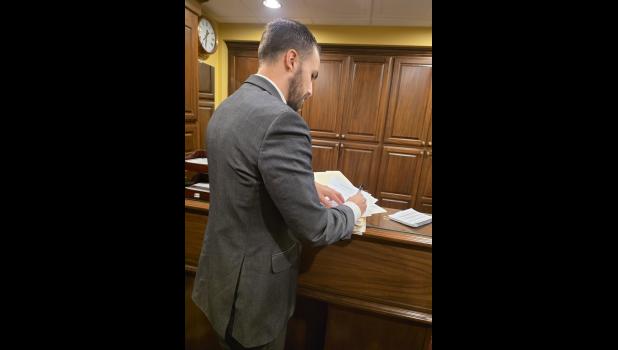
December has been an exceptionally busy and productive month. To date, I have filed more than 20 bills, many of which originated from conversations with constituents. This work has required extensive meetings and discussions related to the proposed legislation. I have traveled to Jefferson City at least twice this month; first to pre-file legislation, and again to sponsor and help host the 2025 Capitol Choir Event, as well as to meet with Senators regarding sponsorship and coordination of several bills for the upcoming 2026 legislative session.
I was especially proud to welcome students from Ava School and Gainesville School to the Capitol. Their performances were outstanding, and their talent was on full display. For those who were unable to attend, videos of their performances are available on my Facebook page.
In the last two weeks, I met twice with the University of Missouri regarding the growing issue of Alpha-Gal Syndrome (AGS) in the southern part of our state. During my first visit, I toured Mizzou’s clinical research facilities and saw firsthand the outstanding work being done at the University. I met Dr. Ben Casterline, a clinical researcher specializing in AGS, along with department leadership overseeing clinical research.
Dr. Casterline is currently applying for several grants focused on Alpha-Gal Syndrome, including efforts to develop and test potential desensitization protocols for individuals affected by AGS. He has also expressed his intent to testify in support of our Alpha-Gal legislation (HB 1855) when it is referred to committee. These meetings were highly informative, and the University of Missouri has expressed support for our proposed Alpha-Gal reporting legislation. This legislation would allow the state to better verify the prevalence and geographic spread of AGS so Missouri can make data-driven decisions to assist those affected and help combat its continued spread.
My second meeting was with University of Missouri Extension personnel. Earlier this year, MU Extension distributed a statewide survey to individuals living with Alpha-Gal Syndrome, and the resulting data has been instrumental in shaping their ongoing initiatives. Year one of these efforts focused on consumer education; year two will shift toward physician and healthcare provider education; and year three will involve training for public and private commercial kitchens on Alpha-Gal awareness and best food management practices.
I was encouraged to see representation from Congressman Burlison’s office at this meeting, with the Congressman’s Field Director in attendance. His engagement and thoughtful questions reflected a growing interest at the federal level in understanding and addressing Alpha-Gal Syndrome. It is encouraging to see coordination beginning across local, state, and federal levels of government on an issue that affects communities throughout Missouri. I remain hopeful that continued collaboration with Missouri’s congressional delegation will further strengthen our ability to address AGS through research, education, and data-driven policy solutions. I have also held several meetings with members of the Missouri Nurses Association and have been coordinating closely with their members on legislation aimed at expanding access to primary healthcare in our communities, particularly our Transition-to-Practice legislation (HB 1635/1636). I am optimistic that we will see movement on these bills during this session through our strategic partnership and shared advocacy efforts. While the strongest opportunity to fully address this pressing issue may not come until the 2027 legislative session, I remain cautiously optimistic.
In addition to this work, my office has filed several bills and a couple joint resolutions addressing key priorities for Missouri families, veterans, and small businesses. This includes HJR 105, which focuses on providing property tax relief and constitutional clarity for Missouri veterans, and HJR 106, which addresses structural concerns impacting fairness and accountability within our state’s economic framework. Alongside these efforts, I continue to advance legislation aimed at pushing back against monopolistic and anti-competitive practices that harm consumers, limit competition, and disadvantage local businesses and producers. These initiatives reflect a commitment to fairness, transparency, and ensuring Missouri’s policies work for those who live and work here.
It is truly an honor to serve the people of our district as your State Representative. I am grateful for the trust you have placed in me, and I remain committed to working diligently on your behalf. As we head into another busy but productive legislative session, I humbly ask for your continued prayers and support as we work to advance policies that strengthen our communities and our great state.
Missouri House Sets Record on First Day of Pre-Filing for 2026 Session
The Missouri House set a new single-day pre-filing record on Monday, December 1, the first day of filing for the 2026 legislative session. Representatives submitted 485 bills on the first day surpassing the previous record of 372 bills set in 2022.
While the session officially begins on Wednesday, January 7, pre-filing allows lawmakers to introduce legislation in advance, highlighting priorities and shaping the policy agenda ahead of the opening gavel. Under House rules, any bill submitted between December 1 and the start of the session is considered “pre-filed” and formally introduced on the first day. Members may continue filing bills through March 1, though the first day typically accounts for a substantial portion of total filings.
For the 2026 session, lawmakers are expected to tackle a wide range of issues, including abortion legislation, gun rights, tax reforms, professional licensure, workforce and education policy, foreign ownership of Missouri land, and AI regulations. To follow newly filed bills throughout the pre-filing period, visit the Missouri House of Representatives website at www.house.mo.gov and select the “Pre-filed Bills” link.
Missouri Remains at Center of National Redistricting Fight
Missouri continues to play a major role in the national battle over congressional redistricting as both parties invest heavily in a referendum effort targeting the state’s newly enacted congressional map. The map, approved by the General Assembly in September, would eliminate a Kansas City–based Democratic seat and shift the state’s delegation further toward Republicans ahead of the 2026 elections.
The group People Not Politicians submitted roughly 300,000 signatures on December 9—far more than the 107,000 required—to force the map to a statewide referendum. However, Secretary of State Denny Hoskins says the map will still take effect on Thursday, arguing that signatures must first be verified before any law can be suspended. He also maintains he may declare the referendum unconstitutional if the petition qualifies for the ballot.
The issue is already tied up in multiple court challenges. On Tuesday, Cole County Circuit Judge Chris Limbaugh ruled that lawmakers had the constitutional authority to enact the revised map. More than half a dozen lawsuits are pending over both the map and the referendum process, including a federal case brought by Attorney General Catherine Hanaway asserting that blocking the map through referendum would violate state and federal constitutional provisions. Other lawsuits, including cases from the ACLU and People Not Politicians, challenge mid-decade redistricting and the ballot language drafted for the referendum.
Hoskins will send petition pages to local election authorities within two weeks, who will have until July 28 to verify signatures. He also said he will exclude signatures collected before October 14—the date he certified the referendum petition—removing roughly 90,000 signatures from review.
If the petition ultimately qualifies in six of the state’s eight congressional districts, the referendum would appear on the November 2026 ballot unless lawmakers set an earlier election date. Candidate filing for the 2026 cycle begins in February, meaning the new map would be used unless a court intervenes.
National organizations on both sides have poured money into the fight, with more than $2 million opposing the referendum and more than $1.25 million supporting it—an unprecedented level of funding for a Missouri ballot initiative. Court rulings expected in the coming weeks will determine whether voters have the final say next year, a decision with implications for the balance of power in the U.S. House.
State Board of Education Signals Openness to Public School Open Enrollment
The Missouri State Board of Education has approved its legislative priorities for 2026, including language supporting “voluntary public school open enrollment.” The move indicates the board wants to be involved in shaping any legislation on the issue, though members expressed differing views on what open enrollment should look like.
Open enrollment proposals—allowing students to attend school in neighboring districts—have passed the House repeatedly in recent years but have stalled in the Senate. Board President Mary Schrag said including the topic in the board’s priorities ensures the department remains part of discussions as lawmakers consider how such a system would operate.
Education Commissioner Karla Eslinger told the board she wants the department to help guide policy details if lawmakers advance open enrollment, noting that the legislature continues to debate how best to structure choice within the public system.
Some board members raised concerns about potential impacts on smaller districts and said they want clearer policy language, with one board member cast a vote against adopting the priorities, citing unanswered questions about what the board is endorsing.
Alongside open enrollment, the board’s priorities include fully funding the state’s K-12 foundation formula and creating a statewide initiative to strengthen math instruction.
State Announces New Funding for Pregnancy Resource Centers
The Missouri Department of Social Services announced a new funding opportunity to support Pregnancy Resource Centers, Maternity Homes, and Diaper Banks across the state. Through the Office of Workforce and Community Initiatives, qualifying organizations may apply for up to $14,135 each to help expand services for Missouri families. The funding is intended to strengthen family well-being and improve access to essential resources, including prenatal care referrals, parenting education, diapers, formula, and other support services. Organizations may apply through the department’s bidding portal under Solicitation No. SDA549262, with the potential for additional funding if all eligible agencies do not apply.
USDA Approves Missouri Waiver to Restrict Certain SNAP Purchases
The U.S. Department of Agriculture has approved Missouri’s request to limit the use of SNAP benefits for purchasing certain junk food items beginning in 2026. Under the waiver, SNAP benefits will no longer be permitted for the purchase of candy, prepared desserts, soda, beverage mixes, and select juice products containing 50 percent or less natural fruit or vegetable juice.
The Missouri Department of Social Services submitted the waiver in September, with implementation anticipated on October 1, 2026. The approval was announced by U.S. Agriculture Secretary Brooke Rollins and U.S. Health and Human Services Secretary Robert F. Kennedy Jr.
Missouri is one of six states receiving approval for similar changes, joining Hawaii, North Dakota, South Carolina, Tennessee, and Virginia. The waivers modify the federal definition of “food for purchase” under the Supplemental Nutrition Assistance Program.
If you ever have, any questions or concerns feel free to call me at 573-751-2042 or email me at Matthew.Overcast@house.mo.gov. Our office is always here for you.