
WILLOW SPRINGS TUESDAY STUDY CLUB
Wed, 10/27/2021 - 1:02pm
admin
2021 FALL PARTY
The Willow Springs Tuesday Study Club met at Club 60 in Mountain Grove on October 5, 2021 to begin their 96th season. Party hostesses were Pauline Cape, Kathleen Carel, Mary Knott and Claudia Marvin, who decorated Club 60's meeting room with an abundance of Fall decorations provided by Claudia and Pauline.
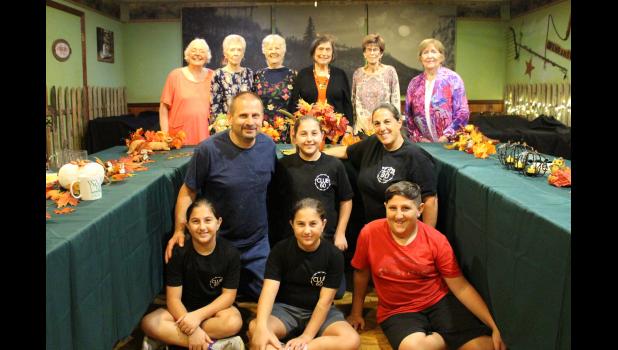
The wonderful lunch included a very tasty Rosemary chicken with roasted grapes and shallots served with lovely whipped ginger sweet potatoes, prepared by Master Chef Jim Alessi and Kaylee, one of the delightful Alessi triplets. A “to die for” dessert of carrot cake with a cream cheese frosting was prepared by Angel Alessi, the Queen of Desserts. The meal was served by two more of the delightful Alessi triplets, Karena and Kandi.
After everyone’s appetites were sated, Kathleen gave a presentation about peanut butter and jelly sandwiches.
The rise and fall of the iconic sandwich has paralleled changes in Americans’ economic conditions.
There was a time when peanut butter and jelly, spread generously on two simple slices of bread, was a quintessential American meal. But sometimes a great rise can also mean a great fall. And the mighty PB&J has fallen. By the twenty-first century, the PB&J had gone from a symbol of doting mothers and idyllic childhood to a marker of negligent parenting and unhealthy kids. What took the sandwich from iconic to outdated?
The PB&J was at its peak in the second half of the twentieth century. This was due to a few factors. Because you could take it anywhere, it was a bridge between public and private life. The sandwich symbolized “home,” but it was just as often eaten outside of the house on picnics, camping trips, and school cafeterias. It also connected generations—both adults and kids enjoyed it. Lastly, it bridged economic gaps as a staple of the working class and much of the country during times of economic hardship. All classes of Americans munched on PB&Js.
Though it became a food for all, the sandwich has a surprisingly elite origin. It began as a fancy tearoom treat for the upper class. The first published mention of the sandwich was a 1901 article in Boston Cooking School Magazine, which suggested spreading peanut paste and currant or crab-apple jelly on finger sandwiches. But by the 1910s, the sandwich was being heralded as the solution to the problem of the schoolboy’s lunch, since it was also enjoyed by children.
Its mainstream popularity was also due to industrialization, as companies figured out how to extend the shelf-life of bread, peanut butter, and jelly. A reader and potential PB&J eater in 1901 would have likely made all three of those ingredients, but by the 1920s and 1930s, urban American cooks were becoming more food consumers than producers. Shelf-stable peanut butter hit the shelves around this time, as did the yardstick for which all great inventions are measured—sliced bread.
Now that a PB&J could be made cheaply, it became a staple as the country entered the Great Depression, finding its way into school lunches and food aid programs. But it could also be part of American assimilation: In a condescending reference to foreign and minority groups that was common for the era, the New York Times praised the government program for helping teaching non-native students to “eat American.” The sandwich was well on its way to becoming not just food, but a signal of Americanness.
The PB&J was also heavily marketed as a good choice for families, and for Baby Boomers, it was the sandwich, as their mothers made thousands of peanut butter and jelly sandwiches. As this rising generation grew up, the PB&J even found its way into activist circles, with organizers for 1963’s March on Washington suggesting marchers bring the sandwich for sustenance during the long rally.
By the 1990s, as concerns about processed foods and allergies began to enter the conversation, the PB&J’s popularity began to decline. But this could be speaking to something much larger: The apparent decline of the PB&J and simultaneous shrinking of the American middle class should make us reconsider the relationship between food and class in America today.
After Kathleen’s presentation, the ladies gave birthday wishes and sang “Happy Birthday” to the Alessi triplets, as it was their 12th birthday. Two of the girls’ brothers, Jared and Jordan, were also there to wish the girls a happy birthday.
A period of relaxing and socializing followed until it was time to head home with take-home boxes, everyone satisfied with an enjoyable beginning to Study Club’s 96th season.