
The Civil War Destruction of the Irish Catholic Community at Wilderness
Tue, 10/28/2025 - 1:45pm
admin
By:
Lou Wehmer
When fall rains slowly reveal the intensifying colors of autumn, my mind is drawn to one of my favorite places along the Eleven Point River: Bliss Spring, and to an especially scenic day in October. For five decades, I’ve floated, fished, and camped on gravel bars along the river passing through what is today called the Irish Wilderness. It is a place of beauty and history, some of it tragic. The story of the thriving Irish Catholic community established there before the Civil War parallels that of the fledgling communities of Howell County, which suffered almost total population and property losses.
It was this time of year, in October 1863, that a Union cavalry patrol rode into the colony and surprised a group working in a field harvesting and threshing wheat along the Eleven Point River. When four men bolted and ran from the patrol, they were ridden down and shot, foretelling the future destruction of the colony.
To explain, by returning near the beginning, the Irish part of this story begins with the potato famine of 1848, and the failure of the Irish farming industry that started in 1845 and lasted until 1851, killing over two million of Ireland's eight million people at the time. The resulting diaspora emptied Ireland of many more of its people, scattering them across the globe. Thirty-three thousand Irish settled in St. Louis, Missouri, eventually becoming a third of the city's population.
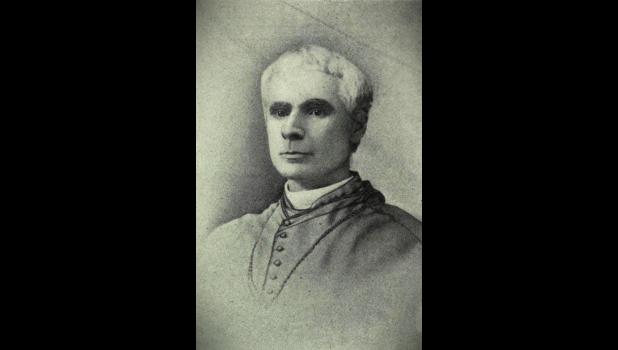
One of the Irish who arrived here in 1848 was a nineteen-year-old Catholic lad from Limerick County, Ireland, John Joseph Hogan. The youngest of nine children, Hogan sailed for five weeks from Liverpool to New Orleans. There, he found misery not unlike what he had experienced in Ireland; a cholera epidemic was ravaging settlements along the Mississippi. Hogan boarded a steamboat bound for St. Louis with plans to enroll in a Catholic seminary there. Upon arrival the day after Christmas 1848, he found the seminary full and was sent to Alton, Illinois, to help in a church there until an opening occurred. It was probably a good thing, as cholera was taking over 250 lives daily in St. Louis.
Hogan was called back to seminary, ordained a priest in 1852, and served the parishes in and around St. Louis. He had a penchant for missionary work and quickly became a church planter. The people he served included enslaved Africans who labored in the lead mines in Potosi and Old Mines in Washington County, Missouri. He founded a new parish in the City of St. Louis, but in 1857, he sought and received permission to start new missions in outstate Missouri.
First going to north Missouri, Father Hogan came in contact with poor Irish immigrant men working as transient railroad laborers under conditions often worse than those of the enslaved Black people he had previously seen. Slaves, as valuable property, were better cared for than cheap Irish workers. Father Hogan was aware that in St. Louis, men often could not find work because of a glut of labor and, by necessity, had to leave their families to work building railroad tracks. In the city, girls were frequently the only members of a household who could find work as low-paid household servants. These conditions separated and strained families and kept the Irish in abject poverty. He desired to find for the Catholic Irish a quality of life better than the poverty and destitution of Ireland and to escape the prejudice against them by Anglos and Germans prevalent in St. Louis.
Hogan sought to remove this impoverished group as a whole to a place where they could make a fresh start and live together as families, in what he perceived as an idyllic colony. The Graduated Lands Act offered a possible solution if funds could be raised to buy land for his people, and Hogan initially sought land in North Missouri. There, he found that farm land was already bought up and now being resold for five to twenty dollars an acre. In the wilds of the Ozarks, land was still available for as little as twenty-five cents per acre.
In 1857, Hogan took a trip to the government land office in Jackson, Missouri, to review a plat map and government surveys of available land, and hired a local surveyor to accompany him. He initially checked a tract that spanned ground in present-day Carter County, near Ellsinore, along Ten Mile Creek, which flows toward the Black River into Butler County, near Poplar Bluff. He found the land suitable for his needs. But competition from eastern settlers and land speculators was so intense that by the time he filed for the land, it was already taken.
Wanting to buy a tract large enough to host his entire re-settlement group, Hogan turned his mission eastward. He checked land in Reynolds, Shannon, and even Howell County, but nothing seemed to be the right fit. In 1859, a fellow Catholic priest, James Fox, solved Hogan's problem by buying 320 acres on the Oregon-Ripley County line and donating to the mission. There, a forty-foot-square log building was erected and divided into a chapel or church in one half and a priest's quarters in the other.
In a reminiscent book, "On the Mission in Missouri," written by Hogan and self-published in 1892, he recalled,
"Already in the spring of 1859, about forty families were here, building houses, digging wells, opening roads, plowing and sowing ground, on lands purchased east and west of the Current River, in the counties of Ripley and Oregon. Many more were coming." By comparison, West Plains was slightly bigger with around fifty households and 150 inhabitants.
He continued, "The little chapel amid the forest trees in the wilderness was well attended. Nowhere could the human soul so profoundly worship as in the depths of that leafy forest, beneath the swaying branches of the lofty oaks and pines, where solitude and the heart of man united in praise and wonder of the Great Creator."
The Irish were not alone in the river hills of their new settlement. A great migration from the east was arriving weekly and claiming land in the vicinity, or were already there when the Irish came. Hogan described his neighbors in his book under the heading "Society in Southern Missouri." He wrote,
"In keeping with these scenes were the simple, quiet ways of the early settlers of southern Missouri, who were mostly from North Carolina and Tennessee, and of whom much may be said in praise. They were kindhearted, honest, sincere, and sociable. No stranger ever travelled amongst them without feeling his heart warmed with the fullest conviction, that, if worthy his presence gave them pleasure, that he was treated to the best they had or could afford, and that his person money and property were safe and sacred in their keeping. Vice was little known amongst them. Intemperance was nowhere observable, although they usually took as a matter of course, their morning dram, or a drop with a friend, from a keg of the best, distilled by themselves or by some neighbor willing to share or barter on accommodating terms. Everyone smoked, men and women, young and old. The weed grew abundantly and was usually the best-tended patch of crop on the place. There was no need of manufactured tobacco or of fancy pipes. Home growth and home manufacture found favor. Corncob pipes were easily made, and for pipe stems, cane was abundant. It grew along the streams and by the water's side. The maidens and swains married young, usually before twenty, often at sixteen, and their married life was remarkably virtuous and happy."
Hogan went on to describe the settlers, now his neighbors, living a self-sufficient, happy but straightforward, idyllic life, in harmony with their neighbors. He told of how the settlers were anxious to get acquainted with the priest. Catholics were a rarity in this part of Missouri at the time, but Hogan believed their manner was more curiosity than prejudice. In fact, many likely had Irish Catholic roots, though early writers often reported that the isolation of the hinterlands had led many to lose their religion.
There were those with strong non-Catholic convictions, and Hogan wrote of one encounter, "The preachers began to hold meetings and revivals near the Catholic settlement, and in those places where the parties lived who were known to be inclining towards the Catholic Church. At one of these meetings, a preacher named Tim Reeves, who was afterwards a notorious guerrilla leader during the war, delivered the following discourse, aimed directly at some persons before him, who were preparing for baptism in the Catholic Church, and who reported his words to me. 'Wait,' said he, 'until the Catholic Church gets hold on some of you, and then you will know what it is to be a Catholic.'"
According to Hogan, Primitive Baptist Minister Tim Reeves accused him of idolatry and asserted that Hogan was there to cheat them out of their money. Reeves, in his own right, was a church planter too, traveling a wide circuit in Southern Missouri, spreading his brand of the gospel. Hogan dismissed Reeves as a poor, ignorant man, and the conflict didn't seem to escalate further. Hogan was on one occasion physically assaulted by a man in Ripley County, but saved serious injury by a local judge who urged him to prosecute the aggressor. Hogan declined and told the judge, "I forgive him from my heart, and I pray God to forgive him and mend him."
Ironically, this hint of religious conflict doesn't seem to have carried into the war and the fate of the Irish here. Some men in the colony ended up in the Confederate Army under the command of their alleged enemy, the Baptist minister Reeves, who turned Confederate company commander. Hogan, who was still responsible for his parish in north Missouri, returned there in late 1859. He never saw the colony again. When the war began, Hogan's allegiance was with the Union; yet as the war progressed, it appears a Union cavalry patrol under the command of a Catholic Major was responsible for the deaths of at least four men of the Wilderness Mission.
Following the War, Father Hogan was arrested by Union authorities for refusing to take the Ironclad Oath required of anyone preaching the gospel during the Radical Republican reconstruction period.
The Irish settlement established by Catholic Priest John Joseph Hogan was only two years old when the war began and consisted of fewer than 100 people. Minus their leader, who left in December 1859 and did not return, the deeply impoverished Irish were ill-prepared to survive as a community during a guerrilla war. Like Howell County's citizens, the Irish were trapped between warring factions that were more interested in preying on them than protecting them. By the end of 1863, the Irish were gone. By comparison, West Plains, with a similar population, disappeared and was destroyed in the same time frame.
Throughout this part of the Ozarks, attrition was steady, beginning with voluntary recruitment of men into both armies. As the war progressed, conscription and the draft forced reluctant men into the military. Muster rolls of Timothy Reeves' Confederate Fifteenth Missouri Cavalry contain several members of the Irish Colony, despite Reeves' pre-war animosity toward Father Hogan and the Catholic faith. The Irish community was located along a north-south road connecting the Union stronghold of Pilot Knob in Iron County, Missouri, and Confederate Arkansas. Numerous military patrols by both armies passed through the community, often taking food, crops, animals, equipment, and people.
In May 1863, Confederate Colonel John Q. Burbridge reported to superiors after leading a patrol, "through a country known as the Wilderness, after marching 28 miles, I was compelled to halt and encamp without obtaining a particle of forage for my horses."
In September 1863, Union forces under the command of Union Major James Wilson left Pilot Knob with a 200-man patrol that scoured the Eleven Point River in search of guerrillas. Passing through the Irish Wilderness, Wilson's men clashed with a group he identified as guerrillas, who were in fact part of Timothy Reeve's Confederate Fifteenth Missouri Cavalry commanded by Lieutenant Duckworth. Spending nearly a month in the area, Wilson's task force reported killing five men and wounding two others. Some 79 prisoners were rounded up, along with 70 horses. Wilson's subordinate officers reported a scarcity of food for the troops and forage for horses, and a relief wagon train of supplies had to be sent to them. On the return trip to Pilot Knob, a special convoy of prisoners and "a train of refugees from Oregon County" was sent northward. This "train" is believed to have been mostly Irish colonists.
To the north, Father Hogan was having his own war-related trials and tribulations. Though federal troops protected the town of Chillicothe, his travels over his parish required him to use the railroad, which was under constant attack by guerrillas. During the war, he survived no less than twenty-one railroad wrecks and missed being a victim of Bloody Bill Anderson's Centralia Massacre, September 27, 1864, by one train. Anderson stopped the train that followed the one in which Hogan was riding, and twenty-two unarmed federal troops were taken off the train and murdered. Hogan carried federal military passes that likely would have ensured he would have been shot, also.
During the war, Hogan lost contact with his Irish Colony at Wilderness. He could not have physically reached them if he tried, and by the end of 1863, probably would not have found them. He wrote after the war, "My poor settlements suffered irretrievably. The one in Southern Missouri especially became broken and scattered; all who could, having fled therefrom.”
Following the war, the land donated to and held by the Irish settlers mainly remained unclaimed. St. Benedict Parrish at Doniphan attributes its founding to the remnants of the Irish community. Some of the colony land reverted to the county for taxes or was squatted upon and used by others who kept it from being sold on the courthouse steps.
At the turn of the century, with the building of the Current River Railroad connecting Willow Springs and Grandin, much of the Irish Wilderness was clear-cut and abandoned. Falling into government hands again during the Depression, a new growth forest returned with the help of the Civilian Conservation Corps pine-planting, and in the mid-1930s the Irish Wilderness began to be incorporated into the U.S. Forest Service's Fristoe Purchase Unit. In the early 1950s, the Wilderness played a role in the reintroduction of deer and turkey, which were nearly extinct in this part of Missouri.
Over the years, several plans were tried and failed toward further exploitation of the Wilderness area, including an effort to dam the Current and Eleven Point Rivers and even a hydrogen bomb plant. In 1964, parts of the Irish Wilderness were designated as part of the National Scenic Riverways system.
John Joseph Hogan rose in prominence in the hierarchy of the Catholic Church despite a post-war arrest by the federal government for refusing to take the Iron Clad Oath, which was later ruled unconstitutional by the U.S. Supreme Court. Hogan was elevated to Bishop in the St. Louis diocese in 1868 and then served as a Bishop in the Kansas City diocese. It was during his tenure as Bishop in Kansas City that he wrote his memoir "On the Mission in Missouri,” describing his efforts to help his fellow Catholic Irishmen in the Ozarks. Bishop Hogan died in 1913.
In 1892, Hogan wrote of his Colony, "Alas! The devastations of war and the woes and sorrows that follow after it. Who now will build up those waste places? Who now will lead back the poor scattered settlers to their humble but ruined homes? Who now will rekindle for them the light of faith or preach the word of God to them in their little chapel beneath the pines in the forest? Has all that was done and endured there been for nothing? Is there no hope for a place once so dear and so sacred? To the most adorable will of God, whose ways are ever full of mercy and above our understanding, we most profoundly bow."